
- How long should you stand at a standing desk? A simple schedule - November 3, 2026
- Best Standing Desks for Small Spaces: 2026 Buyer’s Guide - November 2, 2026
- Best Monitor Arm (2026): Top Picks by Budget and Desk - October 30, 2026
A sit-stand desk cuts sitting by roughly 60 to 100 minutes a day. In a 271-person trial, that didn’t move blood pressure, and standing burns only about 9 extra calories an hour.
The standing desk pros and cons come down to this: a sit-stand desk reliably cuts sitting time and has eased low back pain in several small trials, but it hasn’t shown the heart, weight, or blood pressure gains that ads promise. Standing still for hours brings its own problems, from sore feet to poor leg circulation. Buy one to change positions often, not to replace walking.
Key takeaways
- A Cochrane review found sit-stand desks cut workplace sitting by 84 to 116 minutes a day, but the gap shrank to about 57 minutes in studies lasting three to 12 months.
- In a 2025 trial of 56 desk workers, sitting 30 minutes and standing 15 lowered worst back pain by 1.33 points out of 10 in three months.
- Standing burns about 0.15 calories per minute more than sitting. That’s roughly 54 extra a day for a 143-lb adult who stands six hours.
- The RESET-BP trial (271 desk workers) found no blood pressure benefit, and a Sydney study of 83,013 adults tied long daily standing to more circulatory problems.
- Dual-motor desks run about $400 to $700. Converters start near $110 but wobble more.
- Both studied sit-stand rhythms work out to about two to 2.5 hours of standing in a 7.5-hour day.
Standing desk pros and cons: the short version
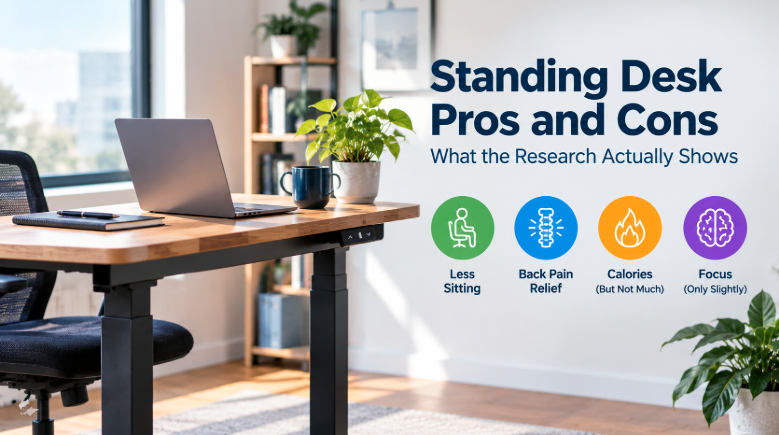
Most standing desk pros and cons claims hold up only partly, and the table below sorts them by how well they’ve been tested. The benefits cluster around sitting less and varying your posture. The drawbacks show up when you stand in one spot for long stretches. Nearly every study here is small or short, so read the verdicts as the current best guess.
| Claim | Best evidence | Verdict |
| Cuts sitting time | Cochrane review, SMArT Work trial | Supported |
| Eases back pain | Trials of 38 to 56 people | Likely, modest |
| Burns real calories | 46-study meta-analysis | Minor |
| Lowers blood sugar | Small, conflicting studies | Unclear |
| Sharpens focus | 44-person Mayo Clinic crossover trial | Slight, short-term |
| Lowers blood pressure | RESET-BP, 271 people | Not supported |
| Standing all day is safe | Sydney study, EU-OSHA review | Contradicted |
Where studies disagree, you’ll see that below. Where a number comes from one small trial, you’ll see that too.
Sit-stand desk raised to standing height with the monitor top at eye level and elbows bent at 90 degrees
Standing desk benefits that hold up: less sitting
Among the standing desk pros and cons, the best-supported benefit is also the plainest. In a Cochrane review of workplace studies, people with sit-stand desks sat 84 to 116 minutes less per day than people with regular desks. The average was about 100 minutes in studies lasting up to three months. Reviewers rated the evidence low quality, and the gap fell to about 57 minutes in studies that ran three to 12 months. Novelty wears off. Cochrane review on reducing sitting at work
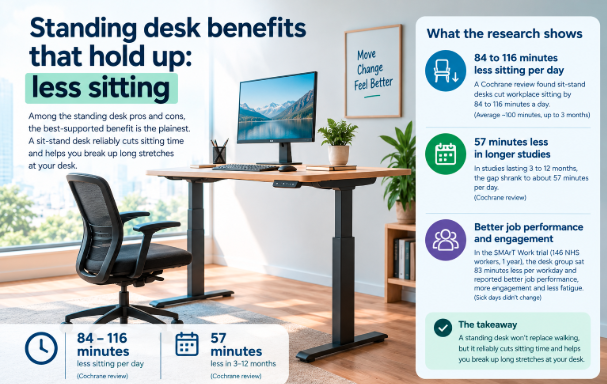
The longest trial worth citing is SMArT Work, which followed 146 NHS office workers for a year. At 12 months, the desk group sat 83 minutes less per workday than the control group. They also reported better job performance, more work engagement, and less fatigue. Sick days didn’t change.
Two limits matter. Those outcomes were self-reported, and the desks came with a workshop and coaching, so the desk didn’t earn all the credit. And the time people stopped sitting went almost entirely to standing. Average stepping and physical activity stayed flat.
So a standing desk does one job well. It breaks up long sitting stretches and gets you out of the chair without leaving your work.
Back and neck pain: the best-supported health benefit
If you’re buying for pain, this is the benefit with real trial support, and it’s still modest. A 2016 trial gave 46 university employees with chronic low back pain a sit-stand workstation. Their current and worst pain dropped over three months.
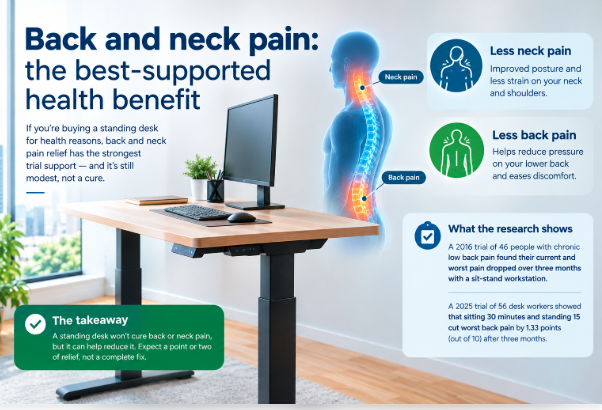
A 2025 randomized trial of 56 desk workers with back pain compared two routines. Sitting 30 minutes and standing 15 cut worst pain by 1.33 points on a 10-point scale after three months. A self-chosen routine cut worst pain by 0.69 but left average pain unchanged. The trial also saw improvements in neck pain, stress, and concentration.
Results aren’t uniform. A six-month trial of 38 office workers found discomfort fell in the desk group and held steady in the controls, but the gap between the groups was small enough to be chance. A UT Southwestern health article cites a small 2018 study where a sit-stand desk plus coaching cut low back pain by half. The RESET-BP lead researcher, Bethany Barone Gibbs, still points to back pain relief as a reason these desks help.
Expect a point or two of relief, not a cure. If the pain persists, see a doctor.
Calories, blood sugar, and focus: smaller wins than advertised
Calories first, because those claims are the most inflated. A meta-analysis of 46 studies and 1,184 people found standing burns 0.15 calories per minute more than sitting. For a 65 kg (143 lb) person standing six hours, that adds up to about 54 calories. A medium banana has roughly 105.
Blood sugar results conflict. One small study of 10 office workers found a 43% smaller glucose rise after 185 minutes of standing. A study of postmenopausal women found a 34% smaller rise. But a crossover trial that had people stand for two hours after a meal found no difference from sitting. Alternating posture every 20 minutes did help in another study, and a meta-analysis found short walks beat standing. If blood sugar is your reason, walk after meals.
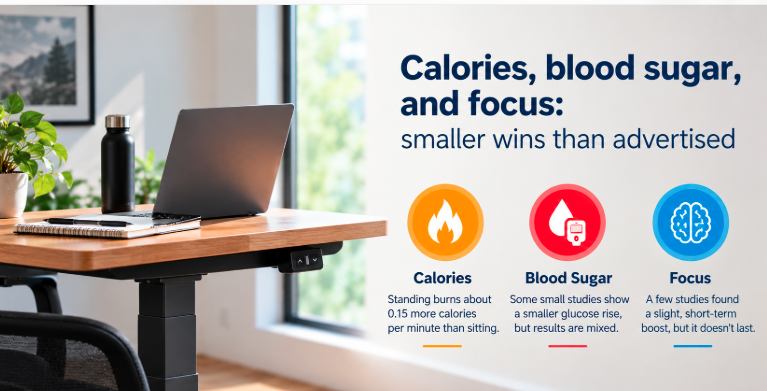
Focus gets a small nod. Mayo Clinic’s 2024 trial put 44 people through four days at sitting, standing, stepping, and walking workstations. Reasoning scores were better on the active setups, typing slowed a little, and accuracy didn’t change. Four days tells you nothing about month six.
What heart and blood pressure studies actually found
This is where marketing and trials split. RESET-BP, published in Circulation in 2024, followed 271 desk workers with mildly elevated blood pressure for three months. The intervention group sat 1.15 hours less per day and stood 0.94 hours more. Resting blood pressure, 24-hour blood pressure, and arterial stiffness didn’t change. The authors concluded that about an hour of extra desk standing shouldn’t be prescribed as a treatment for high blood pressure. Standing outside work hours was linked with better arterial stiffness, so desk standing and off-the-clock standing behave differently. RESET-BP trial in Circulation
The Sydney study analyzed 83,013 UK adults over seven to eight years. Standing more didn’t improve cardiovascular outcomes. Each extra 30 minutes of standing beyond two hours came with 11% higher risk of circulatory problems, such as varicose veins and blood clots. Sitting past 12 hours a day raised heart disease risk 15% per added hour. The study tracked total daily posture, not desk use, so it can’t say how much desk standing is too much. Lead author Matthew Ahmadi summed it up:
“…standing for too long will not offset an otherwise sedentary lifestyle”
The researchers weren’t telling anyone to go back to sitting, since long sitting carried its own risk. Their advice was more movement and regular exercise.
Disadvantages of standing desks that listings skip
Product pages cover price and maybe sore feet. These downsides are worth knowing before you click buy.
- Static standing hurts. EU-OSHA’s summary of occupational studies links standing in place to more low back complaints: about 50% more at two to four hours a day, and double beyond four. Those studies covered workers who stand in fixed positions, not sit-stand users. The pattern is still why you shouldn’t stand all day.
- Cheap frames wobble. Below roughly $300, most desks have a single motor and shake at standing height. That ruins typing and rattles your monitor.
- Laptops fit badly. The screen and keyboard are attached, so one is always at the wrong height. You need a separate keyboard plus a monitor or riser.
- Storage disappears. Many electric frames have little or no drawer space.
- Repairs take weeks. ReviewGeek points out that a failed motor can leave you without a desk while it’s fixed.
- Some tasks feel worse. Some people find drawing and other detailed work easier seated.
None of these sink the standing desk pros and cons for a typical office worker. Most are fixable with a better frame, a monitor arm, and a timer. The static standing risk isn’t. That one depends on you.
How long to stand each day
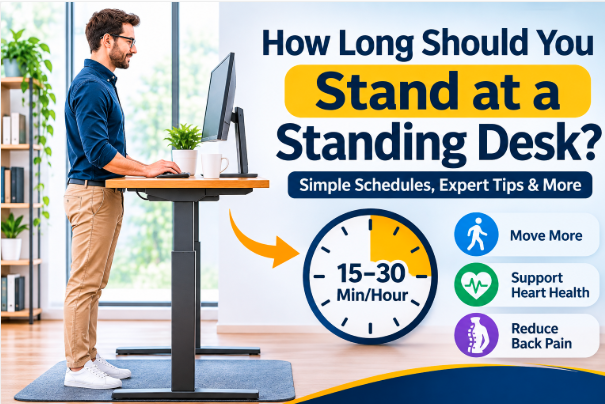
Of all the standing desk pros and cons, usage advice is the most contradictory. Cornell ergonomics professor Alan Hedge proposed 20-8-2: every half hour, sit 20 minutes, stand 8, and move 2. Many guides push a simple 30:30 split. The only trial in my research that compared routines directly, the 2025 back pain study above, favored 30 minutes sitting to 15 standing over a self-chosen rhythm.
Run the math and the two studied options land close together. Over a 7.5-hour desk day, 20-8-2 puts you on your feet about two hours, and 30:15 puts you there about 2.5. A 30:30 split would be roughly 3.75 hours. That’s a big jump, so start lower.
Four-week sit-stand schedule shown as a timeline of sitting and standing blocks
A four-week ramp-up
This schedule is my suggestion, built on those two rhythms. No trial tested it.
- Week 1: Stand for 5 minutes every 30 minutes.
- Week 2: Switch to 20-8-2, including the two minutes of walking or stretching.
- Weeks 3 and 4: Move to 30:15 if back pain is your reason for buying.
- After that: Keep total desk standing near two to 2.5 hours, and sit down as soon as your feet or back complain.
Who should buy a standing desk, and who should skip one
The standing desk pros and cons shift with why you’re buying, so match your reason to what the trials tested.
| Your situation | Verdict | Why |
| Sit most of the workday, back feels stiff | Buy | Cuts sitting time, and small back pain trials point the right way |
| Want lower blood pressure | Skip as a treatment | RESET-BP showed no change in three months |
| Want to lose weight | Skip as a plan | About 54 extra calories a day |
| Varicose veins or swollen legs | Ask your doctor first | Long standing is linked to circulatory problems |
| Budget under $300 | Buy a converter | A $110 to $190 riser keeps your current desk |
| Detailed drawing or precision work | Try before committing | Some people find it harder standing |
If you already break up your day with frequent walks, a standing desk adds less. If you don’t, it’s an easy way to change position without leaving your screen.
Standing desk vs converter: what to spend in the US
Price tracks stability more than health benefit. Review sites in 2026 put a solid dual-motor electric desk at roughly $400 to $700, and desks under about $300 usually have one motor and more wobble. Converters sit on your existing desk and cost less. Prices below come from 2026 roundups and move with sales, so confirm before ordering.
| Option | Typical US price | Stability | Pick it if |
| Budget converter (Vivo, FlexiSpot M7B) | $110 to $190 | Some wobble with heavy monitors | You want to test the habit first |
| Mid converter (VariDesk Pro Plus 36) | About $429 | Steady, no assembly | You’re keeping your current desk |
| Premium converter (Ergotron WorkFit-TL) | About $579 | No visible wobble under dual monitors in one test | You run two monitors |
| Dual-motor desk (FlexiSpot E7) | About $430 to $500 | Steady at full height | You’ll use it all day |
| Dual-motor desk (Uplift V3) | About $599 | Steady, three-stage frame | You want custom sizes |
Motors fail first, so warranty length is the cheapest quality signal. The Uplift V3 carries a 15-year warranty that covers motors and electronics, and it spans 22.6 to 48.7 inches with a 355-lb capacity. The FlexiSpot E7 has a 15-year frame warranty
For more picks, see best standing desks and standing desk converters.
Setup mistakes that cancel the benefits
A well-built desk can’t fix a bad setup, and a perfect setup fails if you never move. Check these five before blaming the desk.
- Wrong elbow height. Set both heights so your elbows bend near 90 degrees, then save them as presets. Tall users should confirm the desk’s maximum height first.
- Low monitor. Put the top of the screen at eye level to spare your neck. If you work on a laptop, add a separate keyboard.
- Hard floor. Stand on an anti-fatigue mat to ease foot and leg soreness. anti-fatigue mats
- Wrong shoes. Heels and dress shoes make standing worse, so wear supportive shoes or keep a pair at your desk.
- Frozen posture. Shift your weight, step, or stretch, and set a 30-minute timer so you change positions.
Anti-fatigue mat under a standing desk with a pair of supportive shoes beside it
Standing desk pros and cons: the decision framework
Three questions settle most purchases.
First, do you sit most of the day and want an easy way to break it up? If so, a sit-stand desk is a sound buy. That’s the strongest evidence in this article: 60 to 100 fewer sitting minutes a day, plus modest back pain relief in small trials.
Second, are you buying for blood pressure, weight, or blood sugar? Don’t. The 271-person trial found no blood pressure change, standing adds about 54 calories a day, and walking beats standing for glucose. Spend that money on a walking habit and treat the desk as a bonus.
Third, do you have vein problems, leg swelling, or an injury? Talk to your doctor before standing for long stretches.
If you buy, spend about $400 to $700 on a dual-motor frame, or $110 to $190 on a converter to test the habit. Stand roughly two to 2.5 hours a day in blocks of 8 to 15 minutes, set a timer, and add real movement. Change position often, and don’t count the desk as exercise.
FAQ
Are standing desks worth it?
Yes, if you sit most of the day and want an easy way to change positions. They cut sitting by an hour or more and have eased back pain in small trials. They’re a poor buy as a blood pressure or weight loss fix.
How long should you stand at a standing desk each day?
Aim for about two to 2.5 hours, split into blocks of 8 to 15 minutes. That matches the 20-8-2 and 30:15 rhythms. Sit down when your feet or back start to ache.
Do standing desks help with back pain?
Often, a little. A 2025 trial found a 1.33-point drop on a 10-point scale, though other trials showed smaller or mixed gains. Persistent pain needs a doctor.
Are standing desks bad for you?
Standing still for long stretches is. A Sydney study of 83,013 adults tied each extra 30 minutes beyond two hours to 11% more circulatory problems. Alternating positions is the safer approach.
How many calories does a standing desk burn?
About 0.15 more calories per minute than sitting, or roughly 54 extra a day over six hours. That’s about half a medium banana. Walking burns far more.
How much should you spend on a standing desk?
Plan on $400 to $700 for a stable dual-motor desk, or $110 to $190 for a converter. Desks under about $300 usually have one motor and wobble. A longer warranty is a decent sign the motors will last.