
- How long should you stand at a standing desk? A simple schedule - November 3, 2026
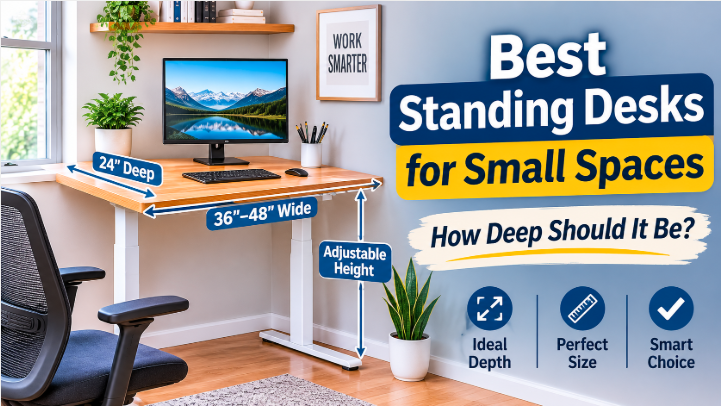
- Best Standing Desks for Small Spaces: 2026 Buyer’s Guide - November 2, 2026
- Best Monitor Arm (2026): Top Picks by Budget and Desk - October 30, 2026
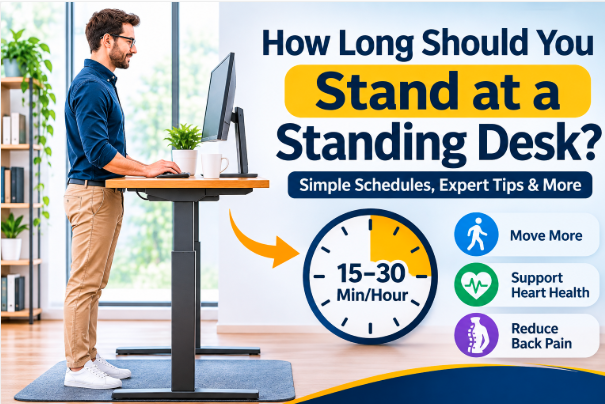
Stand for about 15 to 30 minutes of every hour, then sit or walk. That’s a sensible starting point, and it beats the old advice to stand as long as you can.
So, how long should you stand at a standing desk? For most office workers, aim for 15 to 30 minutes per standing block and about two to four hours of total standing and light movement across an eight-hour day. No study has proven one perfect number, so the best schedule is the one that keeps you changing positions and pain-free.
Office worker standing at an adjustable desk with monitor at eye level
Key takeaways
- Start with 5 to 10 minutes of standing per hour in week one, then add a few minutes each week.
- Keep standing blocks near 30 minutes, and sit or walk before aches begin.
- A daily total of two to four hours matches expert guidance that counts standing and light walking together.
- Past two hours of standing a day, a large 2024 study linked each extra 30 minutes to a higher circulatory risk.
- Three hours of standing burns roughly 24 extra calories, so it breaks up sitting but doesn’t replace a workout.
- Varicose veins, plantar fasciitis, knee problems, and pregnancy call for shorter blocks and a doctor’s input.
How long should you stand at a standing desk?
Two numbers matter: how long each standing block lasts, and how many hours you stack up by the end of the day. For blocks, 15 to 30 minutes works for most people. For the daily total, a 2015 expert statement in the British Journal of Sports Medicine told desk workers to build up to two hours of standing and light activity, then progress toward four hours.
That guidance has two catches. It counts walking, not just standing still. And the authors said the evidence behind it was largely observational or short-term.
A newer data point pushes the other way. A University of Sydney study of 83,013 UK adults found that after two hours of standing a day, every extra 30 minutes was tied to an 11% higher risk of orthostatic circulatory disease. That group of conditions includes varicose veins. The researchers counted all standing, not just desk time, so the study didn’t look specifically at standing desk use.
Put those together and a practical range appears. Aim for about two hours of desk standing, add walking on top, and treat four hours as a ceiling rather than a goal. If you also sit more than ten hours a day, the sitting is the bigger problem: each extra hour past ten raised cardiovascular risk by 15%.
Why standing desk time recommendations disagree
Search this topic and you’ll see advice from 15 minutes an hour to four hours a day. The gap comes from what each source measured.
Each group asked a different question. Cornell looked at comfort and task performance. Waterloo looked at back pain. Sydney tracked heart and vein disease over years. Cochrane asked whether sit-stand desks reduce sitting at all, and found they probably do, though the studies were small.
Nobody has run a long trial that tests one sit-stand schedule against heart attacks or vein disease. That’s why a range with built-in movement is more honest than a single magic number.Cornell University Ergonomics Web, sit-stand guidance
Sit-stand schedules: how long to stand at your desk each hour
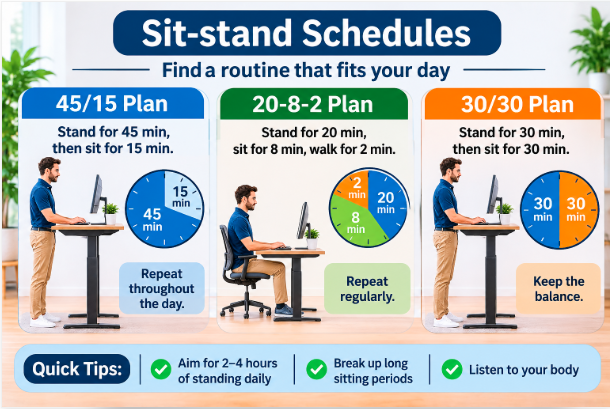
Pick one of these patterns and run it for a week before you tweak it.
| Pattern | How it works | Standing per 8-hour day | Best for |
| 45/15 | Sit 45 minutes, stand 15 | About 2 hours | Beginners, sore feet |
| 20-8-2 | Every 30 minutes: sit 20, stand 8, move 2 | About 2 hours standing, 30 minutes moving | People who like a clear rule |
| 30/30 | Stand 30, sit 30 | About 4 hours | Experienced users with a mat and good shoes |
The 20-8-2 rule comes from Alan Hedge, a Cornell ergonomics professor. It’s tidy, but even desk brands that promote it call it a starting point, not a prescription. Hedge’s own math for a 7.5-hour day works out to 16 sit-stand transitions and about 30 minutes of moving and stretching.
That’s a lot of getting up. Harvard Health warns that timers can break your concentration and hurt efficiency or creativity. Tie the switch to natural breaks instead: after you send a batch of emails, at the start of a call, or when a meeting ends.
How long to stand at a standing desk in your first month
Your legs and feet need a break-in period, much like new shoes. Expect foot soreness and mild lower-back fatigue for two to four weeks. Harvard Health suggests starting with 30 to 60 minutes a day and building up gradually.
| Week | Standing per hour | Daily total |
| 1 | 5 to 10 minutes | 45 to 75 minutes |
| 2 | 10 to 15 minutes | 1.5 to 2 hours |
| 3 | 15 to 20 minutes | 2 to 2.5 hours |
| 4 | 20 to 25 minutes | About 3 hours |
Move up only if the last week felt easy. If your feet or lower back ache by mid-afternoon, repeat the week instead of skipping ahead. Many people settle near two to three hours, which sits inside the expert range.
Keep each block short at first, even on days when you feel great. Energy on day two doesn’t mean your calves are ready for an hour on their feet.
Signs you’ve been standing too long
Your body sends signals long before real trouble starts. Watch for these:
- Burning or aching arches by mid-afternoon
- Tight calves or heavy legs
- A dull lower-back ache that builds over 20 minutes
- Puffy ankles by evening
- Weight shifted onto one hip, or locked knees
- Shoulders creeping toward your ears
- Fuzzy focus that clears when you sit
In a University of Waterloo lab study, about half the participants with no back history developed low back pain after two straight hours of standing. Researcher Jack Callaghan advises changing position early, because standing-induced back pain is hard to shake once it starts. In a later study, the pain usually faded within 10 to 15 minutes of sitting. Sit down at the first ache, not the fifth. Callaghan’s team also pointed to planks and side planks as core work that helped participants.
Who should stand less at their desk
Some conditions change the math. Check this list before you push toward four hours:
- Varicose veins or chronic venous insufficiency
- Plantar fasciitis
- Significant knee or hip problems
- Pregnancy
- Dizziness when you stand up (orthostatic hypotension)
People with varicose veins, plantar fasciitis, or knee problems may find standing makes symptoms worse, and pregnant women should check with their provider. The Sydney team’s circulatory outcomes included orthostatic hypotension and varicose veins, and the lead author said standing too long could be risky for some people’s circulatory health.
If any of these fit you, try 5 to 10 minute blocks and add short walks. Ask your doctor or a physical therapist what’s safe for you. This guide isn’t medical advice. University of Sydney press release on the 2024 standing study
Set up your desk so standing feels easier
Plenty of “I can’t stand for long” complaints trace back to setup. Fix these before you blame your legs:
- Set desk height to your elbows. Your forearms should rest level with your elbows bent near 90 degrees. Someone around 5’10” often lands near 42 inches.
- Raise the monitor. Put the top edge at or just below eye level, about an arm’s length away.
- Add an anti-fatigue mat. Look for roughly 3/4 inch of cushion. Decent ones typically run $40 to $90. anti-fatigue mat
- Wear supportive shoes. Choose arch support or gel insoles instead of bare feet or thin flats.
- Shift your weight. Rest one foot on a small footrest, switch sides, and avoid locking your knees.
- Back it up with a good chair. Your sitting blocks count too.
Anti-fatigue mat under a standing desk with supportive shoes. standing desk ergonomics setup guide.
Standing desk time works best with movement
Standing still is just a different static posture. The Sydney researchers put it bluntly: standing too long won’t cancel out an otherwise sedentary lifestyle. They pointed to regular movement breaks, walking meetings, and taking stairs as better bets.Build tiny movement into the day:
- Walk for two minutes every 30 minutes, as in Hedge’s pattern.
- Aim for about 250 steps per hour, the goal many fitness trackers use.
- Do 15 calf raises while a file uploads.
- Take calls on foot and pace the hallway.
- Walk during lunch instead of eating at your desk.
If you want to go further, an under-desk walking pad runs roughly $150 to $400 and works at a slow 1 to 2 mph. The Sydney team noted that for people who sit a lot, incidental movement plus structured exercise may do more for cardiovascular risk than standing alone. best under-desk walking pads.
What standing at your desk can and can’t do
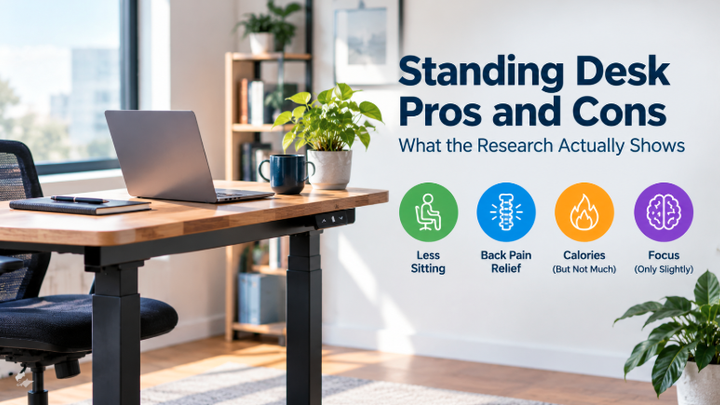
A standing desk does one thing well: it breaks up long stretches of sitting. A Cochrane review found users sat 84 to 116 minutes less per day, though the evidence was very low quality. A Cleveland Clinic occupational therapist adds that standing breaks can improve posture, comfort, and work tolerance over time.
It does less than people hope for weight and heart health:
- Calories: Harvard Health puts three hours of standing at 24 extra calories, about a carrot’s worth
- Heart health: In the Sydney data, standing more didn’t improve cardiovascular outcomes.
- Exercise: Federal guidelines call for 150 minutes of moderate activity a week, and no amount of desk standing replaces that.
Treat the desk as a sitting breaker. The real health work happens in your walks, stairs, and workouts. If you sit ten or more hours a day, cut that number first. best standing desks for home offices
Which tasks to do standing and which to do sitting
Not every task suits every posture. Many people find calls, video meetings, brainstorming, and inbox triage easy on their feet. Branch Furniture notes that creative tasks like brainstorming or phone calls can feel more natural standing, even pacing. Precision work, such as detailed spreadsheet edits or fine mouse control, often goes better seated.
Here’s a sample day that adds up to about two hours standing:
- 8:45 to 9:00: Inbox triage (15 minutes)
- 10:00 to 10:30: Calls (30 minutes)
- 11:45 to 12:00: Prep for lunch meeting (15 minutes)
- 1:00 to 1:20: Post-lunch reading (20 minutes)
- 2:30 to 3:00: Video meeting (30 minutes)
- 3:45 to 4:00: Wrap-up and planning (15 minutes)
The after-lunch slot has a small bonus. Harvard Health notes that advocates cite studies where blood sugar returned to normal faster on days with more standing. Add two short walks and you’ve hit the expert range without watching a timer. harvard
Summary: how to decide how long to stand at your desk
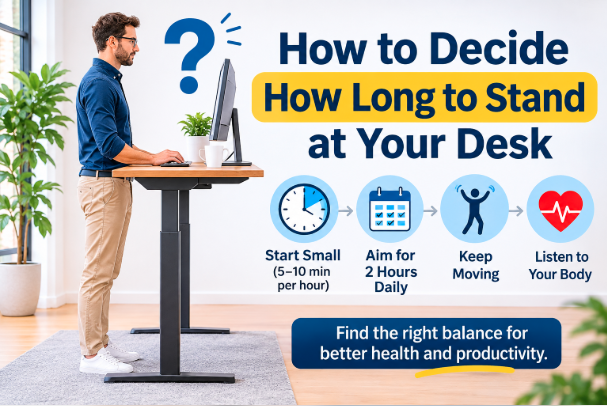
Here’s the whole decision in order:
- Pick your block length. Use 15 to 30 minutes per standing block. Start at 5 to 10 minutes if you’re new.
- Pick your daily total. Build toward about two hours of standing, with four as a ceiling, and count walking on top.
- Choose a pattern. Try 45/15 as a beginner, 20-8-2 if you like rules, or 30/30 once your body is used to it.
- Watch for stop signals. Sit or walk at the first ache. Back pain from standing is easier to prevent than to fix.
- Adjust for your health. With varicose veins, plantar fasciitis, knee issues, or pregnancy, use shorter blocks and ask your doctor.
- Fix the setup. Elbows at 90 degrees, monitor at eye level, a mat, and supportive shoes.
- Add movement. Walk two minutes every half hour. Standing doesn’t cancel out ten hours of sitting.
No source has proven a single perfect schedule. A mixed day of sitting, standing, and walking, tuned to how you feel, is the safest bet the research supports.
Standing desk FAQs
How long should you stand at a standing desk as a beginner?
Start with 5 to 10 minutes per hour in week one. Harvard Health suggests 30 to 60 minutes a day at the outset. Add about 5 minutes per hour each week, and expect sore feet for two to four weeks.
Is it bad to stand at a desk all day?
Yes, standing still for hours has its own costs. About half of Waterloo’s participants developed back pain after two straight hours. Sydney’s data also tied more than 12 stationary hours a day, sitting or standing, to higher orthostatic risk.
Is the 20-8-2 rule backed by science?
Partly. Cornell’s Alan Hedge created it, and a Texas A&M dissertation tested it for task and cognitive performance. No long-term trial tying it to heart or back outcomes turned up in our research. Use it as a template, not a prescription.
Do standing desks help with weight loss?
Barely. Harvard Health puts three hours of standing at about 24 extra calories. Cochrane reviewers noted that standing hardly increases energy expenditure. A brisk 20-minute walk burns several times more.
Should you stand or sit after lunch?
Standing or strolling for 10 to 15 minutes is a smart pick. Some studies suggest blood sugar normalizes faster after meals on high-standing days, though the evidence is early. A short walk beats standing motionless.
Can standing too long at a desk cause varicose veins?
Long-term standing is linked to vein problems, but a desk alone hasn’t been shown to cause them. Sydney’s study tied more standing to orthostatic circulatory conditions such as varicose veins and venous insufficiency. If you already have vein issues, keep blocks short and ask your doctor.