
- How long should you stand at a standing desk? A simple schedule - November 3, 2026
- Best Standing Desks for Small Spaces: 2026 Buyer’s Guide - November 2, 2026
- Best Monitor Arm (2026): Top Picks by Budget and Desk - October 30, 2026
Buy the Branch Duo 36×24 if floor space is your only limit. Choose the Uplift V3 at 42×24 if you’re short, tall, or run two monitors. Skip anything under 40 inches wide unless you only use a laptop.
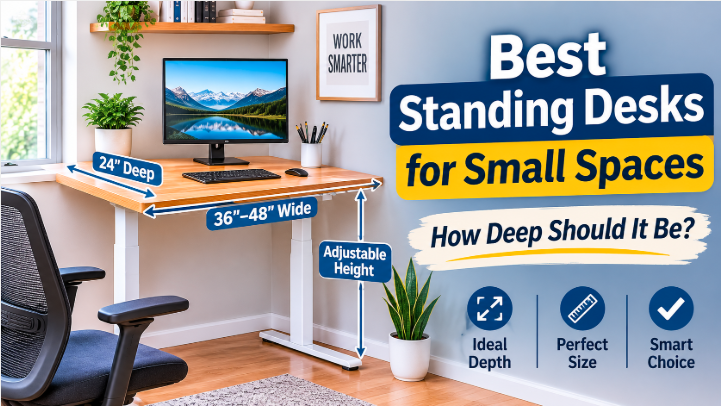
The best standing desks for small spaces stay near 36 to 48 inches wide and 24 inches deep, yet still reach your seated elbow height and hold steady when raised. Width is easy to find. Minimum height and stability at full extension are where compact desks cut corners.
Key takeaways
- A 24-inch-deep top suits most small rooms when your monitor sits on a clamp arm and measures 27 inches or less.
- Check minimum height before width. The Branch Duo starts at 28 inches, the Uplift V3 at about 22.6 inches.
- Leave 24 inches behind your chair to sit and about 36 inches to stand up and walk past.
- Budget single-motor desks often list 176 lbs of capacity, while the dual-motor picks here carry 275 to 355 lbs.
- Many converters need a desk at least 24 inches deep, so measure the one you own first.
- Studies show sit-stand desks cut sitting by 30 minutes to 2 hours a day, though the evidence is low quality.
Disclosure: some links below are affiliate links, and we may earn a commission at no cost to you.
Best standing desks for small spaces at a glance
Every size below reads width by depth, so 36×24 means 36 inches wide and 24 inches deep. Most shortlists of the best standing desks for small spaces end up with the same three desks, and your height and monitor count will narrow them faster than your floor plan will.
| Desk | Smallest top | Height range | Capacity | Warranty | Typical price |
| Branch Duo | 36×24 in | 28 to 47.3 in | 275 lb | 10 years | $499 to $599 |
| Uplift V3 | 42×24 in | 22.6 to 48.7 in | 355 lb | 15 years | About $600 to $800 |
| Budget 40×24 (single motor) | 40×24 in | About 27 to 47 in | About 176 lb | Varies | Under $250 |
Gear Patrol and Tom’s Guide both name the Duo as a pick for small spaces, and Wirecutter’s guide recommends it when room is limited. The Uplift costs more and fits a wider range of bodies. The budget desk saves money and gives up capacity, which starts to matter the moment you add a second monitor.
Compact standing desk with a 36×24 inch top in a studio apartment corner
Measure the room before you open a product page
Desk shopping starts with a tape measure. The average US studio runs about 457 square feet, according to RentCafe’s 2025 data, so every inch you give a desk comes out of the bed, the couch, or the walkway. Write down these four numbers first, because every one of the best standing desks for small spaces passes or fails on them.
- Usable wall width. Measure between obstructions such as outlets, window trim, and baseboard heaters, not wall to wall.
- Depth to the walkway. Measure from the wall to the point where foot traffic starts, like the foot of a bed.
- Chair clearance. Allow 24 inches behind the chair to sit down and about 36 inches to stand and pass behind it. Guides disagree, with advice running from 18 to 36 inches, so use 36 whenever the desk faces a walkway.
- Shelf and ceiling height. Raised desks top out near 48 inches, so any shelf above the desk belongs at 60 inches or higher.
Keep the four numbers on a sticky note while you shop, whether the desk is going in a studio apartment or a bedroom home office. how to measure for a home office desk.
How deep should a standing desk for a small space be?
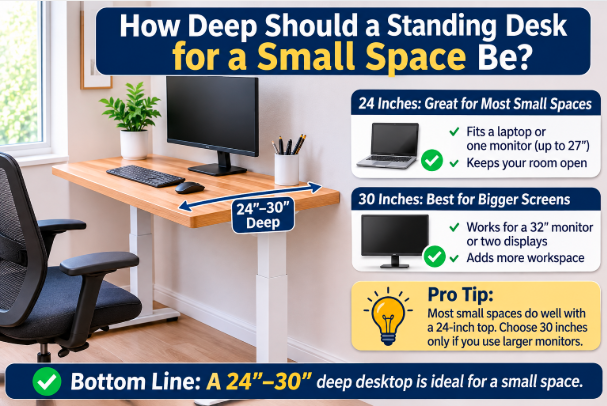
Twenty-four inches works for most people. Thirty is better when your screen is big.
OSHA sets the target that matters here:
“the preferred viewing distance is between 20 and 40 inches (50 and 100 cm)”
OSHA computer workstations guidance OSHA computer workstations, monitors
Your eyes sit a few inches behind the desk’s front edge, so a monitor clamped near the back of a 24-inch top lands inside that range. Put the same screen on its factory stand and things change. One monitor maker figures a 32-inch display’s base takes 9 to 12 inches of depth, which leaves too little room on a shallow top.
That explains the argument on deal forums, where one camp says 24 inches is fine and another says nothing under 29 or 30. They’re describing different monitor setups.
- 24 inches deep: a laptop, or one monitor up to 27 inches on a clamp arm.
- 30 inches deep: a 32-inch screen, any monitor on its own stand, or two large displays.
Most of the best standing desks for small spaces come in 24-inch depths, and deeper tops cost you width. Uplift’s 30-inch V3 starts at 42×30, six inches deeper than its 42×24 and the same width.
Check minimum height before you check width
Plenty of the best standing desks for small spaces start at 28 inches, which suits average and taller users and shuts out shorter ones. FlexiSpot’s own guidance for shorter people warns that even a 26-inch minimum can sit too high, and it points to frames closer to 22 inches.
Here’s how to find your numbers:
- Sit in your real chair with your feet flat and your shoulders relaxed.
- Bend your elbows to 90 degrees and measure from the floor to your elbow. That’s your seated target.
- Stand in your usual shoes, bend your elbows the same way, and measure again. That’s your standing target.
- Compare both against the desk’s listed range, and confirm whether the minimum includes the desktop.
That last check catches real differences. Uplift’s frame sheet lists 21.6 to 47.7 inches for the bare frame, while its V3 listing reads 22.6 to 48.7 with a desktop on it. Pick a desk whose range covers both targets with an inch or two to spare at each end. Wirecutter’s guide described the Branch Duo as a fit for people between 5’8″ and 6’5″, which matches its 28-inch floor and roughly 47.5-inch ceiling.
Branch Duo: the compact pick for studios and bedroom corners
The Duo shows up on nearly every list of the best standing desks for small spaces I checked, and the specs explain why. It comes in 36×24, 48×24, and 58×27 tops on a dual-motor frame with no crossbar, which gives your knees more room than a typical H-frame. Capacity is 275 lbs.
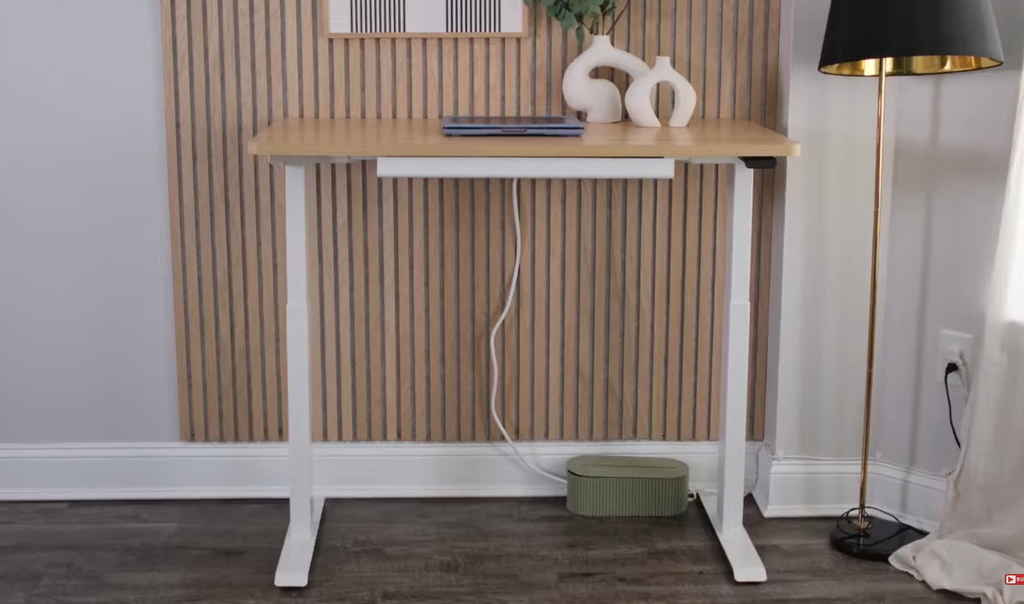
Branch quotes motor noise under 50 dB, and the OLED paddle adds collision detection and stand-up reminders. Tom’s Guide gave it an Editor’s Choice and called it the perfect choice for smaller workspaces. At review time the 36-inch cost $499 and the 48-inch $599, so confirm today’s price. Branch backs it with a 10-year warranty.
Branch Duo 36 inch standing desk raised to standing height in a bedroom corner
Height range depends on who you ask. Branch lists 28 to 47.3 inches, while TechRadar and Tom’s Guide print 47.8. Plan around 47.5.
Who should skip the Duo
- Shorter users. A 28-inch minimum can sit above a comfortable seated elbow height.
- Shared desks. It stores two height presets, while Uplift’s optional keypad stores four. Wirecutter flagged that gap for households that share.
- Nooks under 36 inches. Even the smallest Duo needs 36 inches of wall.
Uplift V3: more range when 42 inches of width is fine
If your nook is at least 42 inches wide, the Uplift V3 earns a place among the best standing desks for small spaces by covering the widest range of bodies in this guide. Tops start at 42×24, and Uplift ships shorter feet for its 24-inch-deep tops. This compact standing desk carries 355 lbs.
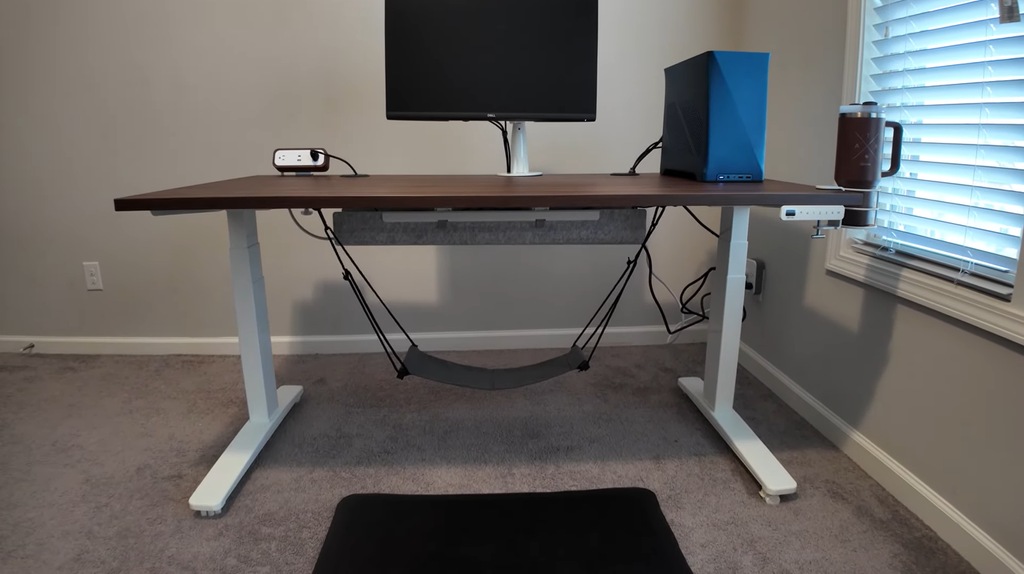
Uplift lists a height range of 22.6 to 48.7 inches. Reviewers print slightly different numbers, with Tom’s Guide showing 22.8 to 48.7 and TechRadar 22.6 to 48.2. Noise runs under 48 dB on Uplift’s frame sheet and under 50 dB in TechRadar’s review. The warranty is 15 years, five more than Branch gives.
Where the V3 pulls ahead is range. A 22.6-inch floor suits shorter users the Duo can’t, and the top end reaches taller ones. Tom’s Guide found that even the smallest 42-inch top left plenty of room to work. The optional advanced keypad stores four presets, which helps if two people share the desk.
Expect to pay roughly $600 to $800 for a 42-inch top, depending on the desktop and keypad you choose. The configurator is the only reliable price source.
The tradeoff is width. If your nook measures 40 inches, this desk doesn’t fit, and no amount of shuffling changes that.
Budget and micro desks under 40 inches wide
None of these budget desks will top a list of the best standing desks for small spaces, but two categories make sense for specific buyers.
Micro desks, 32 to 35 inches wide. Amazon brands sell 32×19 and 35×20 electric desks, with listings showing 28 to 45 inch ranges and 176 lbs of capacity. On a 19-inch top a clamped monitor lands right at OSHA’s 20-inch minimum, which leaves no margin. Treat these as laptop desks.
Budget 40×24 desks, under $250. Tom’s Guide’s budget pick lists 176 lbs, a 27.5 to 46.9 inch range, and a single motor. Fezibo’s 40-inch model has sat near $190 in recent roundups. You get a usable top and a decent range. You give up the dual-motor stability that matters at standing height.
Wobble is the recurring complaint on deal forums, especially where a top overhangs the frame. Motor counts are also missing from many listings, so check the title for “dual motor” before you buy. And buy from a seller with a 30-day return, then raise the desk to full height with your actual monitor on it. If it sways while you type, send it back.
Standing desk converter or full desk: which suits a small room?
A converter sidesteps the hunt for the best standing desks for small spaces by keeping the desk you already own and adding sit-stand height on top. Floor footprint stays the same, which makes it the default answer for renters and for anyone attached to their desk. best standing desk converters.
Specs set the limits. Gas-spring models usually run 26 to 36 inches wide, and VIVO’s K Series models list 33 lbs of capacity. That handles a laptop, or one monitor and a keyboard. One 15-inch-lift converter I checked requires a desk at least 24 inches deep, and its 25×9 inch keyboard tray tops out at an 18-inch keyboard.
Choose a converter when:
- your desk is at least 24 inches deep,
- you can’t swap furniture, and
- your load is light.
Choose a full desk when your current one is shallower than 24 inches, when you run two monitors, or when stability at full height matters more than keeping the old desk. Converters also leave a bulky platform on the surface when lowered, so a desk that doubles as a dining table ends up cluttered. Wobble at full height is the usual complaint, so test one before the return window closes.
Wall-mounted and fold-down desks: the floor-clearing options
Wall-mounted desks rarely make lists of the best standing desks for small spaces, and I didn’t see the height-adjustable kind on any of the ones I checked. Uplift sells one. Its frame measures 23.6 inches wide and 11.8 inches deep, takes 42×24 or 48×24 tops, and reaches 22.6 to 48.7 inches under the same 15-year warranty. Almost no floor gets used. The catch is the wall, which means anchoring into studs, so check your lease before you drill.
Fold-down desks are a different product. Listings I checked rated them from about 44 to 150 lbs, and the thinnest folds to roughly 2.4 inches. They don’t adjust in height, so you’d pair one with a tall stool to stand at it.
Depth is the other problem. On a slim fold-down you often can’t push a monitor far enough back, and one retailer’s guide warns your neck will notice within a few weeks.
The verdict is simple. If you own the place and want real height adjustment, go wall-mounted. If you need a laptop surface that vanishes after work, go fold-down.
Make a small standing desk setup work
Even the best standing desks for small spaces feel cramped until you fix how things sit on top of them.
- Swap the monitor stand for a clamp arm. A stand base can take 10 to 12 inches of depth on a 24-inch top, and an arm gives it back. best monitor arms for small desks.
- Mount shelves at 60 inches or higher. Raised desks reach about 48 inches, so a lower shelf blocks the lift.
- Set height limits. Uplift’s controllers let you cap the travel so the desk won’t run into a shelf or cabinet.
- Add a keyboard tray if the desk doubles as a table. It clears the surface for dinner or crafts.
- Route cables early. The Duo has a cable notch, and Tom’s Guide praised the wider tray on Uplift’s V3.
Monitor on a clamp arm above a 24 inch deep standing desk in a small home office
Both brands quote motors under 50 dB, around the level of a quiet conversation. Lift speed runs about 1.3 inches per second on the Duo and 2 on Uplift’s frame, so a full height change takes roughly 10 to 15 seconds.
Summary: how to choose a standing desk for a small space
The best standing desks for small spaces come down to four checks, run in this order.
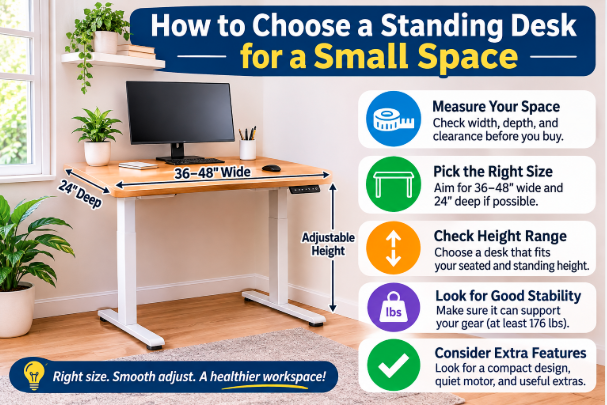
- Measure. Get wall width, depth to the walkway, chair clearance (24 inches to sit, 36 to stand and pass), and shelf height (60 inches or higher).
- Pick depth by monitor. Use 24 inches for a laptop or one clamp-mounted screen up to 27 inches. Use 30 inches for bigger or stand-mounted screens.
- Match minimum height to your seated elbow. If it sits below 28 inches, skip the Duo and look at the V3’s 22.6-inch floor.
- Choose the desk. The Branch Duo (36×24, $499 per Tom’s Guide) fits the narrowest rooms and users 5’8″ and up. The Uplift V3 (from 42×24) fits shorter users, taller users, and shared desks. Uplift’s wall-mounted frame frees the most floor. A budget 40×24 suits light loads, and a converter works when you can’t replace a desk that’s at least 24 inches deep.
One limit applies to every option. Sit-stand desks reduced sitting by 30 minutes to 2 hours a day in studies, on low-quality evidence. Cochrane review, workplace interventions for reducing sitting at work. Buy for fit and comfort, not for a promised health result.
Frequently asked questions
What size standing desk is best for a small room?
For most rooms, the best standing desks for small spaces run 40 to 48 inches wide and 24 inches deep. That holds a laptop and one monitor with space for a notebook. Drop to 36 inches only if you work mostly from a laptop, and go to 30 inches deep for a 32-inch screen.
Is a 24-inch deep standing desk big enough?
Yes, for a laptop or one monitor up to about 27 inches on a clamp arm. OSHA puts your eyes at least 20 inches from the screen, and a rear-mounted arm clears that. A monitor on its own stand wants 30 inches.
How much clearance does a standing desk need behind it?
Plan on 24 inches to sit down and about 36 inches to stand up and walk behind your chair. Check door swing too. Any shelf above the desk should sit at 60 inches or higher.
Are small standing desks wobbly?
Some are. Deal-forum buyers report sway at full height, usually where a top overhangs the frame. Dual-motor frames like the Branch Duo and Uplift V3 are the safer buy, and any desk deserves a test at full height with your monitor on it before the return window closes.
Are standing desks quiet enough for an apartment?
Branch quotes motors under 50 dB and Uplift under 48 dB, about the level of a quiet conversation. Lift speed runs 1.3 inches per second on the Duo and 2 on Uplift’s frame, so a full change takes 10 to 15 seconds.
Do standing desks improve your health?
Evidence is thin. A Cochrane review found they cut sitting by 30 minutes to 2 hours a day on low-quality evidence, with no clear effect on performance or musculoskeletal symptoms. Standing barely burns more energy than sitting, so don’t expect weight loss.